



Choosing the best hardness rating for kitchen knives can transform your cooking experience.
However, many buyers ignore this critical factor. As a result, they struggle with dull edges and frequent sharpening. This guide explains everything clearly and practically. You will understand steel hardness, edge retention, and real kitchen performance.
Most importantly, you will discover the best hardness rating for kitchen knives for your needs.
Understanding Knife Hardness in Simple Terms
Knife hardness refers to how resistant the steel is to deformation. Manufacturers measure it using the Rockwell Hardness Scale. You will often see the abbreviation HRC.
Higher HRC numbers indicate harder steel. Lower numbers represent softer steel. However, harder does not always mean better. The best hardness rating for kitchen knives balances sharpness, durability, and ease of sharpening. Therefore, understanding this balance is essential before buying any knife.
What Is the Rockwell Hardness Scale?
The Rockwell scale measures metal resistance under pressure. It determines how deeply an indenter penetrates the steel surface. Most kitchen knives fall between 52 and 66 HRC. Yet, not every range suits every cook. The best hardness rating for kitchen knives depends on cooking style and maintenance habits.
For instance, professional chefs often prefer harder blades. Meanwhile, home cooks may benefit from moderate hardness.
Why Hardness Matters in Kitchen Knives
Hardness affects edge retention directly. Harder knives stay sharp longer. However, they may become brittle. Softer knives resist chipping better. But they dull more quickly. Therefore, the best hardness rating for kitchen knives combines strength with flexibility. This balance improves both safety and performance.
Additionally, proper hardness enhances slicing precision. It also reduces frequent sharpening sessions.
Ideal Hardness Range for Most Home Cooks
For everyday cooking, 55–60 HRC works well. This range offers durability and easy sharpening. Many popular Western-style knives fall within this category. They handle vegetables, meats, and fruits effectively. If you seek the best hardness rating for kitchen knives at home, start here. This range provides dependable performance without fragility.
Moreover, maintenance remains simple for beginners.
Professional Chef’s Preference for the best hardness rating for kitchen knives
Professional chefs often prefer 60–64 HRC. This higher hardness allows razor-sharp edges. Japanese knives commonly feature this range. Brands from Japan are especially known for high-hardness blades. However, harder blades require careful handling. They may chip if misused.
Still, many professionals consider 60–62 HRC the best hardness rating for kitchen knives in commercial kitchens. It offers excellent cutting precision and edge longevity.
Western vs Japanese Knife Hardness
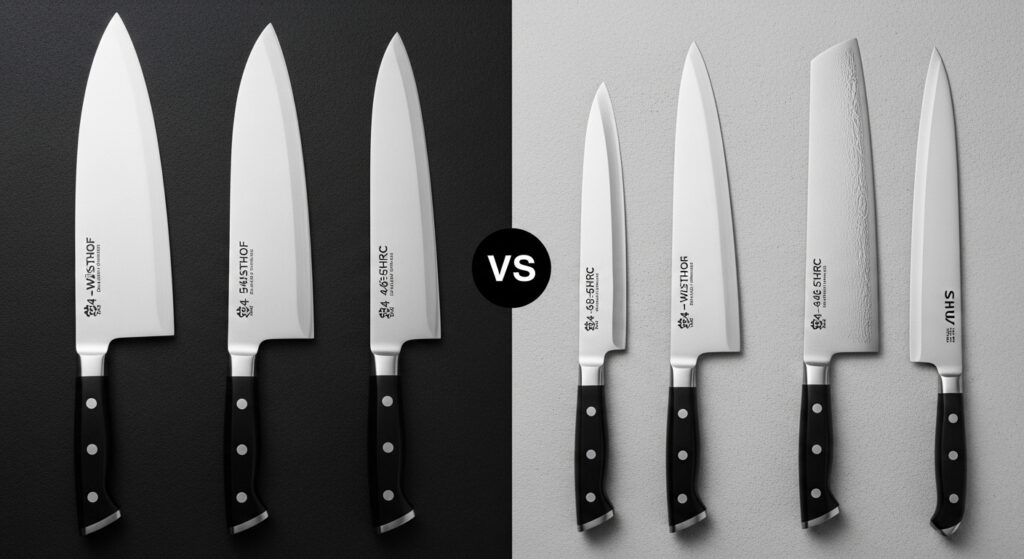
Western knives typically range from 54 to 58 HRC. They prioritize toughness and impact resistance. In contrast, Japanese knives range from 60 to 66 HRC. They emphasize sharpness and clean slicing. For example, brands like Wüsthof use moderate-hardened steel. Meanwhile, Shun focuses on harder steel compositions. Both styles can represent the best hardness rating for kitchen knives. The ideal choice depends on your cutting habits.
Hardness and Edge Retention
Edge retention improves with increased hardness. Therefore, high HRC knives remain sharp longer. However, sharpening becomes more challenging. Hard steel requires quality sharpening stones. If you dislike frequent maintenance, higher hardness may suit you. Yet, beginners may struggle with repairs.
Thus, the best hardness rating for kitchen knives balances edge longevity with sharpening ease.
Hardness and Durability
Hardness also affects durability differently. Harder blades resist wear but chip easily.
Softer blades bend instead of breaking. Consequently, heavy-duty tasks favor lower hardness.
For example, cutting bones requires tougher steel. In contrast, precision slicing favors higher hardness.
Therefore, selecting the best hardness rating for kitchen knives depends on the food type.
Carbon Steel vs Stainless Steel Hardness
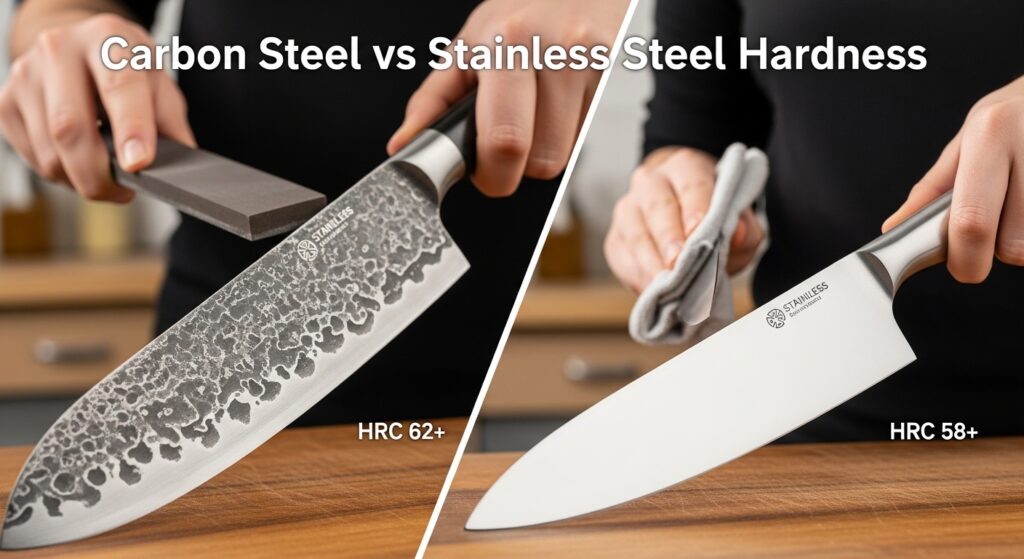
Carbon steel knives often reach higher HRC levels. They maintain exceptional sharpness.
However, they require careful maintenance. Stainless steel offers corrosion resistance.
Its hardness usually stays slightly lower. Both materials can achieve the best hardness rating for kitchen knives. Your environment and cleaning habits determine the better choice.
Heat Treatment and Its Role
Heat treatment significantly influences hardness. Even premium steel performs poorly without proper treatment. Skilled manufacturers control temperature precisely. They optimize toughness and edge stability. Therefore, the best hardness rating for kitchen knives also depends on production quality. Always consider brand reputation before purchasing.
When Hardness Is Too High
Extremely hard knives above 65 HRC are fragile. They may chip during normal use. Additionally, sharpening becomes time-consuming. Specialized tools may be required. For most kitchens, this level exceeds practical needs. Thus, avoid extreme hardness unless you are experienced. The best hardness rating for kitchen knives rarely exceeds 64 HRC for daily cooking.
When Hardness Is Too Low
Knives below 52 HRC dull quickly. They require constant honing and sharpening. Moreover, edge precision decreases noticeably. Cutting becomes less efficient. Although such knives resist chipping, performance suffers. Therefore, they seldom represent the best hardness rating for kitchen knives.
Finding the Perfect Balance
Balance remains the key factor in knife performance. Neither extreme hardness nor extreme softness works universally. For most users, 58–62 HRC provides optimal performance. This range ensures sharpness and manageable maintenance.
Therefore, many experts recommend this as the best hardness rating for kitchen knives overall.
Maintenance Tips for Different Hardness Levels
Hard knives require gentle cutting boards. Use wood or rubber surfaces only. Avoid twisting motions during cutting. Additionally, never use them on frozen foods. Softer knives need regular honing. They respond well to basic sharpening tools. Regardless of hardness, proper care extends lifespan. Consequently, maintenance supports the best hardness rating for kitchen knives.
How to Check Knife Hardness Before Buying
Manufacturers usually list HRC in product descriptions. However, some brands omit this detail. In such cases, check official websites or packaging. Reputable companies disclose steel specifications clearly. If information remains unavailable, reconsider the purchase. Transparency reflects quality control.
Knowing the number helps you choose the best hardness rating for kitchen knives confidently.
Common Myths About Knife Hardness
Many believe harder knives never dull. This assumption is incorrect. Others think softer knives are inferior.
That claim also lacks accuracy. Performance depends on multiple factors. Steel composition and heat treatment matter greatly. Therefore, hardness alone does not define quality. Yet, selecting the best hardness rating for kitchen knives remains crucial.
Final Recommendation
For beginners, choose 56–58 HRC. For serious home cooks, select 58–60 HRC. For professionals, consider 60–62 HRC. These ranges consistently deliver reliable results. They minimize risk while maximizing cutting performance. Ultimately, the best hardness rating for kitchen knives lies between 58 and 62 HRC.
This range satisfies most cooking environments worldwide.
Frequently Asked Questions
1. What is the best hardness rating for kitchen knives for beginners?
Beginners should choose 56–58 HRC.
This range offers durability and easy sharpening.
2. Is a higher HRC always better?
No, higher HRC increases brittleness.
Balance is more important than extreme hardness.
3. Do Japanese knives have higher hardness ratings?
Yes, many Japanese knives exceed 60 HRC.
They focus on precision and edge retention.
4. What hardness rating lasts the longest?
Knives around 60–62 HRC maintain edges the longest.
However, proper care still matters greatly.
5. Can soft knives be good?
Yes, softer knives resist chipping.
They suit heavy-duty kitchen tasks well.
